Dawn’s Early Light: A Ministry of Peculiar Occurrences Novel. By Pip Ballantine and Tee Morris. New York: Ace Books, 2014.
Napoleon Solo and Illya Kuryakin . . .
Kelly Robinson and Alexander Scott . . .
John Steed and Emma Peel . . .
Scarecrow and Mrs. King . . .
Annie Walker and Auggie Anderson . . .
Agents Ward and Skye . . .
. . . Wellington Thornhill Books and Eliza D. Braun.
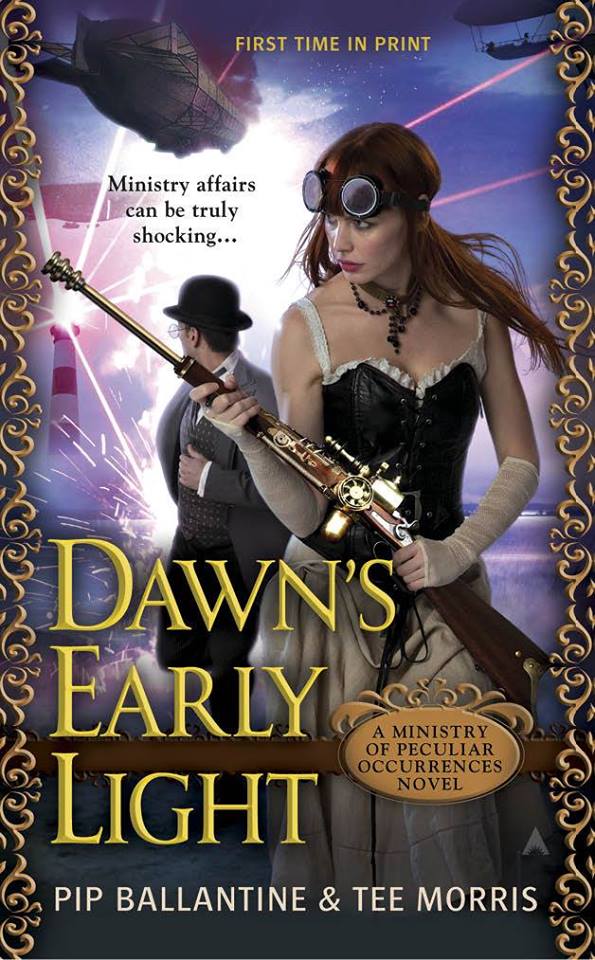 The annals of popular espionage fiction — especially the sort that’s written and read in a spirit of fun — resound with tales of teammates who became friends, and, in more recent pairings, considerably more than friends. (Spouses Pip Ballantine and Tee Morris could be added to the latter group, but I doubt their story bears any similarity whatever to those in the above list.) In the case of Agents Books and Braun of HRM Queen Victoria’s Ministry of Peculiar Occurrences, romantic tension can be frustrating, especially when it interferes with getting the job done. And when the job involves airships mysteriously disappearing off the coast of North Carolina, you really don’t want distractions.
Books and Braun illustrate two time-honored principles. The first one — “Opposites Attract” — is widely repeated. The second — “Opposites Have a Devil of a Time Communicating” — is widely swept under the rug but refuses to stay hidden. It’s tragic in a drama, but in a comedy it makes for considerable will-they-or-won’t-they fun.
And make no mistake: Dawn’s Early Light is fun.
You see, toward the end of their previous book-length adventure, The Janus Affair, Wellington Books planted a solid one on Eliza Braun in the Ministry’s Archives, and Eliza is still trying to deal with it. She remembers him saying he considered her safety more important than that of the Ministry itself . . . but since then, nothing. He’s been the perfect gentleman, but that’s about it.
Nor are things any more encouraging on the other side. Now that the Ministry has assigned Books and Braun to assist colleagues in the United States (partly as a way of getting them out of the English spotlight; while they did solve their last case, it was most definitely not by the book), Books discovers that agent “Wild Bill” Wheatley of America’s OSM (Office of the Supernatural and Metaphysical) is tall, handsome, rugged, and likes to play with guns. In other words, he’s just the kind of guy Eliza Braun would go for. And that’s exactly what she seems to be doing.
Meanwhile, the four of them — the fourth being the beautiful Felicia Lovelace, who promptly sets her cap for Wellington Books — must find out why dirigibles are vanishing, crew and all, off the Outer Banks. Is a supernatural manifestation to blame? If so, then why would Thomas Edison show up in the middle of it all — in circumstances that make him look like the villain of the piece? And what connection does it have to Ministry consultant Nikola Tesla and perennial Ministry nemesis the House of Usher?
As you can guess from the cover’s tagline, “Ministry affairs can be truly shocking,” electricity is involved. We are still firmly within the “steampunk” genre, but here the hiss of steam is in energetic dialogue with the zap of electrical current.
Like its two predecessor novels, Phoenix Rising and The Janus Affair, Dawn’s Early Light revels in steam-powered technology, operating non-stop. Much of it is provided by Agent Books, who is no slouch with a screwdriver and who maintains a marginally respectful relationship (in point of fact, he’s less than impressed) with the Ministry’s Research and Design department. That department, the Ministry’s equivalent of Q Branch, provides some nifty weaponry; but it’s Books who shows us that Babbage’s Analytical Engine can be engineered into a laptop. Of course, no secret agent’s adventures would be complete without an impressive automobile, and Books not only designs and builds but brings to America a motorcar that … well, let’s just say that Ian Fleming would be delighted.
Where Books specializes in knowledge (he is Chief Archivist of the Ministry, after all) and technology, Eliza Braun specializes in smiting men (via flirt or fist) and making things go boom. All their talents get quite a workout as they go from the East Coast to the Wild West to the even wilder West Coast, investigating skullduggery and pursued by skullduggers aplenty. The action does not let up for a moment — authors Ballantine and Morris maintain a pace that alternates between physical and emotional tension, keeping the story moving and the reader anticipating. And there’s a lot to anticipate, because disappearing dirigibles are only the beginning of the villainous plot. The Electric Age is coming to America, and its chief architect does not mean us well.
As for sparks between our two Ministry agents … I’ve learned not to try outguessing Pip Ballantine and Tee Morris. Peculiar Occurrences can crop up at any time, you know.
 Clerk’s postscript: If it sounds as though this writer has had some experience with the Ministry of Peculiar Occurrences, it’s true. Along with their books of the Ministry, Pip and Tee also present short stories in their series Tales from the Archives, which appears both in print and as a Parsec Award–winning podcast.
Volume III of the Tales contains my story “And Why the Sea Is Boiling Hot,” addressing the remarkable invention of the æthergates, which play a part in various Ministry accounts. For specifics, please see www.ministryofpeculiaroccurrences.com.

| NOOK | Smashwords | Kobo]
| Kindle
| NOOK]
(got $3,500?) | Paperback
]
| Kindle
| NOOK]
| Kindle
| NOOK]
]
| Kindle
| NOOK]
]
| Kindle
| NOOK]
]
| Kindle
| NOOK]
]
| Kindle
| NOOK]
]
| Kindle
| NOOK]
]
]
]

